
A Landmark That Both Worlds Share
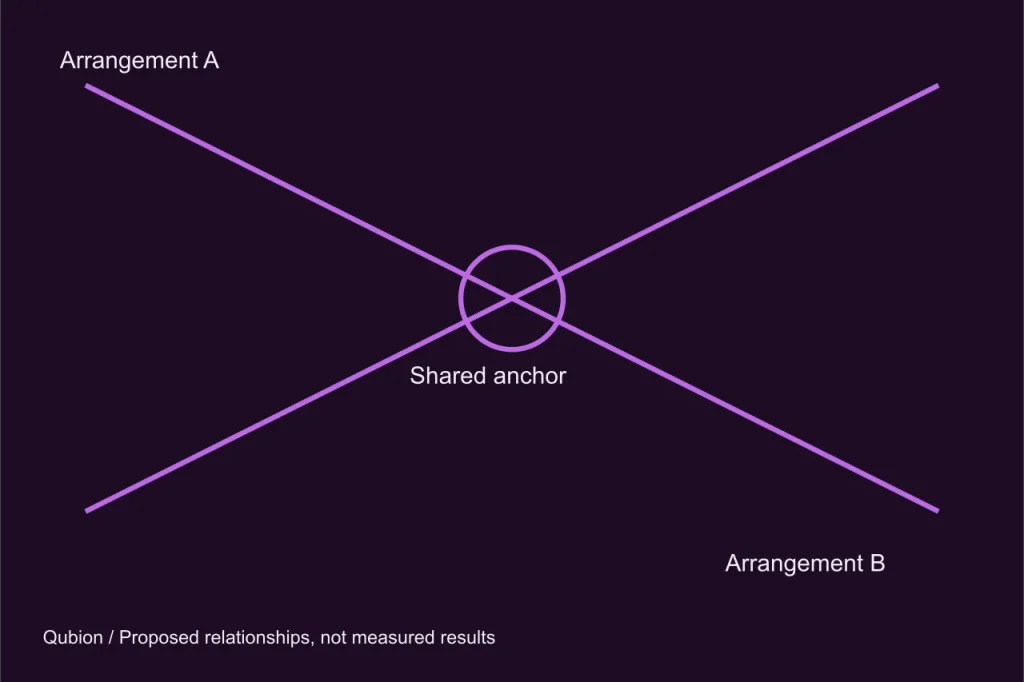
Two versions of a place are difficult to compare if nothing recognisable survives the change. The proposed opening of Both Banks therefore begins with a shared stone. It occupies the same meaningful position in two incompatible bridge arrangements. This note considers what makes that stone useful as evidence, and why repeating an object is not enough by itself to establish a readable relationship.
Give the anchor a job
The stone needs to do more than decorate the middle of a view. It should help the player identify which fragments connect and where a stable pause might be possible. Its role in the route makes it worth remembering. An object that remains unchanged but has no relationship to the player’s next action can be visually consistent without being informative.
We propose introducing the anchor before the first alternate arrangement appears. The wanderer can inspect its broken edge, its height relative to the near bank and the fragment beside it. When the second reality opens, those familiar relationships provide a starting point. The change is then something the player can compare, rather than an entirely new picture demanding a fresh interpretation.
Use more than colour
A lime mark may draw attention to the selected stone, but the mark cannot carry the whole identity. Shape, silhouette and relative position should reinforce it. A distinctive missing corner or a narrow split through the surface can remain visible under different lighting. Plain interface language can name the selected anchor when needed.
The same principle applies to Absent Stair, where a landing or window provides a closer reference. A repeated triangular opening is useful only if it can be distinguished from the other openings in the room. Adding many similar landmarks can reduce clarity even while increasing visual detail.
Preserve the relationship during movement
An anchor that is clear from the starting point may become ambiguous halfway across a bridge. The proposed encounter should therefore be considered from several positions, including the point at which the wanderer must decide whether to continue. A camera that frames the initial view beautifully but hides the relevant stone during traversal would undermine the rule it is meant to explain.
We want the player to understand when a connection depends on keeping an anchor visible. If that condition exists, losing the view should produce a specific signal. If the condition does not exist, the game should not imply it through an unnecessary warning. The visual presentation must follow the actual rule rather than create a second, accidental rule of its own.
Distinguish shared from merely similar
Two stones can look alike without being the same anchor. That distinction can support a later puzzle, but it is a poor first lesson. The opening case should establish an unambiguous shared object. More complex scenes can then introduce resemblance as a question, with evidence that lets the player resolve it.
A shared landmark should also remain consistent in the game’s own records. If a journal illustration shows a different break or a different position, players may reasonably treat that discrepancy as a clue. Concept art and explanatory diagrams therefore need to be reviewed against the intended relationship, not only against a palette.
What an early check would ask
This is a design proposal, not a report of measured player performance. A useful first exercise would show the two arrangements without labels and ask which object provides a reliable comparison. A second would ask what the object helps the viewer infer about the route. If people can recognise the stone but cannot explain its relevance, the encounter still needs work.
The view-transition note takes the next step: once a useful anchor exists, the transition should not erase it through an unnecessary camera jump. Stable evidence gives an impossible world enough consistency to become a place the player can reason about.