
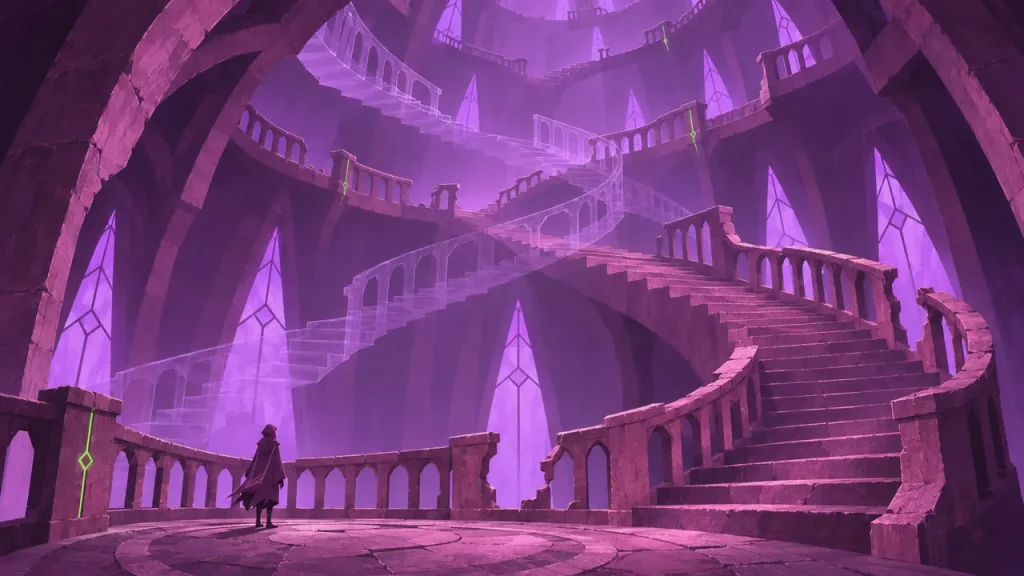
Absent Stair is a spatial exploration concept set inside an observatory that cannot agree on the arrangement of its own floors. One version contains a stair that rises from a circular landing. Another contains the destination floor but no stair beneath it. A quantum wanderer must understand where the arrangements overlap and use those stable relationships to move through the building.
A room before a puzzle
The observatory begins with a small, readable space: a landing, a window, a stair and a closed upper gallery. Each element has a distinct silhouette and a clear position relative to the others. The first alternate view changes one important relationship while preserving enough of the room for the player to remain oriented. The design should not demand that visitors reconstruct the entire building from memory after every switch.
A window can reveal a structural seam that continues through both arrangements. A broken railing can identify the same landing from a different height. These objects are not decorative rewards; they are the vocabulary through which the building explains itself.
Locate, compare, align, traverse
The proposed loop starts by locating a stable landing. The player compares the adjacent arrangements, aligns a visible connection and traverses the section that becomes coherent. At the next stable place, the previous relationship can be released. This creates a sequence of local decisions rather than one giant puzzle requiring the entire observatory to be solved simultaneously.
The alignment action should have an explicit target. A camera movement alone must not accidentally commit a change simply because the player looked around. We propose a distinct acknowledgement of the chosen seam or opening, followed by a preview of the route it makes available. The exact control scheme remains a design question rather than an announced feature.
Experiment without losing the room
Spatial puzzles benefit from trying an interpretation and seeing what changes. The concept therefore needs an understandable undo boundary. Reversing the most recent alignment could restore the previous arrangement while leaving the wanderer on a shared landing. A larger reset should explain which part of the route is being reconstructed, rather than abruptly moving the camera to an unfamiliar place.
The undo proposal examines this distinction. We want experiments to reveal relationships, not make players afraid to touch a control. At the same time, an unlimited rewind that hides every consequence could make the building feel arbitrary. The stable landing provides a concrete place to negotiate that balance.
Light as orientation, not a secret code
Violet ambient light establishes the observatory’s atmosphere. Muted rose surfaces separate older structural elements from suspended additions, and sparse lime markers identify selected connections. Essential information must also appear through shape, position and plain interface language. Colour alone cannot explain whether a stair exists in one arrangement or both.
The reference-preserving view note considers camera transitions. A visual change can be dramatic without rotating the room so far that the player loses the landmark they were trying to compare. Reduced-motion presentation should retain the same state information.
A concept with a limited first goal
Absent Stair is currently a concept, not a released game. The first intended study is a short ascent through a handful of connected rooms, each extending a familiar relationship. There is no public release date or store listing. The related Both Banks dossier approaches the same problem at landscape scale, providing a useful contrast between distant anchors and the close structural details of an interior.