
Undo Without Erasing the Question
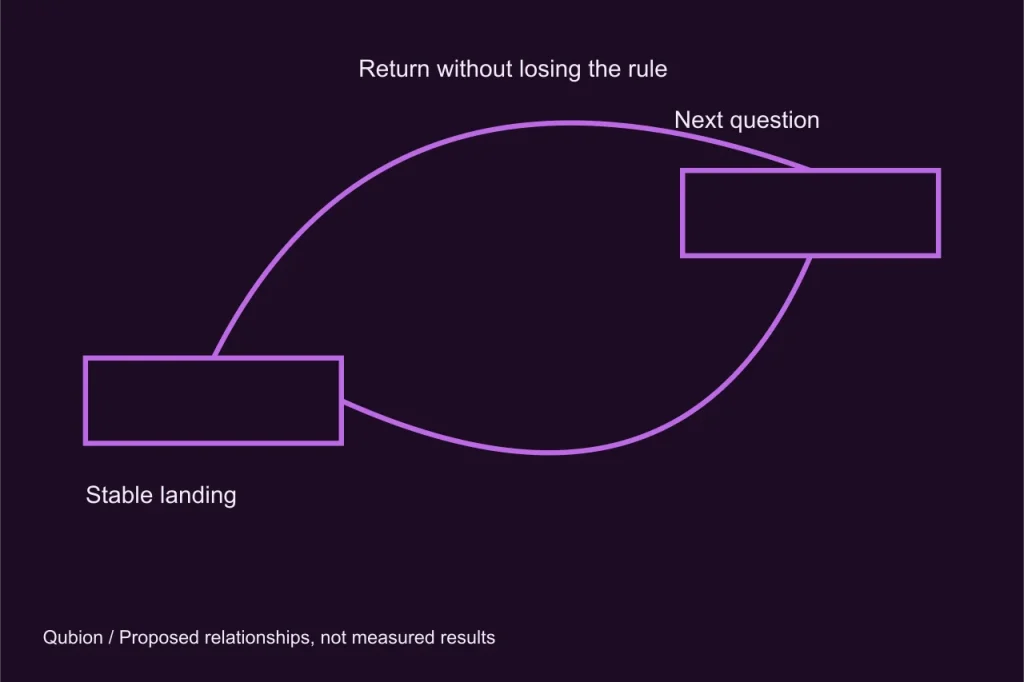
An experiment that fails can still teach the player something useful about a space. The challenge is to let them reconsider without making the world’s rules feel disposable. In Absent Stair, shared landings provide a possible answer: a stable place from which an alignment can be tried, inspected and revised. This note considers what an undo action should restore, and what the player should retain from the attempt.
Define the boundary of an experiment
A proposed alignment begins from a known landing and changes a specific connection. Undo can restore that connection’s previous state while returning the wanderer to the shared point. The boundary is spatial and explicit. It is not a promise that every action in the building can be reversed indefinitely.
This scope should be communicated before the experiment. A player who expects one step to be reversible should not discover afterwards that the control resets an entire floor. Conversely, a large reset should not appear to preserve a connection that it actually removes. The name, preview and result of the action must describe the same operation.
Preserve what was learned
The environment can return to an earlier arrangement without requiring the player to forget the relationship they observed. A journal note or a clear state comparison may help retain that information, but it should not automatically solve the next attempt. The useful outcome is understanding why a route failed, not receiving a hidden answer as compensation.
For example, the player may learn that a stair belongs to only one arrangement while its landing is shared. That knowledge changes the next plan even if the room returns to its starting state. The view-transition note explains why a stable reference is necessary for such a comparison.
Avoid punishment for inspection
Reading a connection, moving the camera or opening a description should not accidentally consume the opportunity to undo. Those actions gather information. The commitment boundary belongs to the alignment or traversal that changes the proposed route. Clear separation makes experimentation deliberate instead of fragile.
This also matters for keyboard use. A focused control should identify its target and action without requiring a precise pointer gesture. If a player navigates away to reread an explanation, the current working state should remain comprehensible when they return. Accessibility is part of the rule’s presentation, not an optional layer added after the puzzle is designed.
Give larger returns a different meaning
Sometimes a route may need a broader reset to an earlier stable place. That operation should be distinguished from undoing the latest alignment. A confirmation can describe the connections that will be released and the landing to which the wanderer will return. The player can then choose whether the broader reconsideration is worth abandoning the current route.
The landscape-scale Both Banks concept may require different distances and resting points, but the same principle applies. Returning should reveal the structure of the experiment rather than teleporting the character to a place with no visible relationship to the failed attempt.
Questions for a first study
No finished implementation or playtest result is claimed here. A useful paper study would show a short sequence of alignments and ask which states a particular undo control is expected to restore. Disagreement may indicate that the boundary is unclear. Another question would ask what the player learned from the unsuccessful route and how that knowledge changes the next attempt.
The bridge-rule note provides the complementary view: a route needs an understandable activation and release before its reversal can be meaningful. Undo should support reasoning about those relationships. It should not become a substitute for making the relationships clear in the first place.