
A Bridge Rule You Can Explain
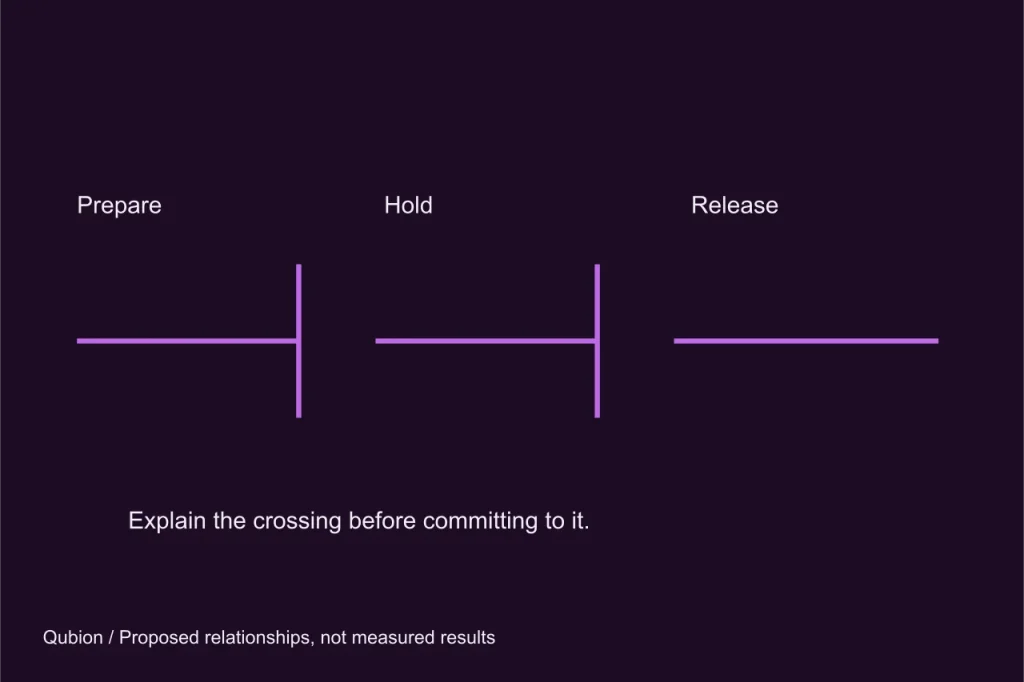
An impossible bridge becomes a puzzle when its behaviour can be understood well enough to form a plan. Without that consistency, the player is only waiting for the environment to permit progress. The Both Banks concept proposes a small relationship between a shared anchor and two incomplete routes. This note asks how to introduce that relationship without turning the opening crossing into a lecture.
State the condition in ordinary language
Before drawing a complex bridge, we want a sentence that explains its central condition. For the first case, the working proposal is that the selected shared stone holds the adjacent fragments together while the connection remains active. The sentence identifies an object, an action and a consequence. It does not describe every later puzzle, but it gives the opening scene a testable intention.
If the rule requires several exceptions before the first step, the encounter is probably too complex. A short crossing can establish one relationship clearly. Later spaces can combine that relationship with another familiar condition rather than repeatedly replacing it with a new special case.
Separate preparation from traversal
The near bank should offer a stable place from which to inspect the route. The player can identify the anchor, compare the fragments and see the next resting point before committing. This preparation is part of the intended play, not an interruption before the real action begins. The architecture should make the relevant evidence available from that position.
Once the connection is held, movement tests the plan. The route should not introduce an unrelated condition halfway across without warning. A change can still occur, but the player needs a way to relate it to the rule they learned. Otherwise a carefully prepared crossing would feel no different from a guess.
Explain release as carefully as activation
Opening a connection tends to receive the most visual attention. Releasing it deserves equal clarity. At a shared resting point, the wanderer should know which fragments will cease to connect and which part of the route remains stable. A release preview can make that consequence visible before the action is accepted.
The goal is not to make every choice risk-free. It is to make the immediate relationship intelligible. A player might deliberately close a route behind them in order to open another, but should understand that trade before doing so. The undo study explores how reconsideration can fit around these boundaries.
Use the environment as evidence
A line in the interface can identify the held connection, but the bridge itself should show which fragments depend on it. Alignment, contact surfaces and a stable anchor silhouette can communicate more than a collection of identical glowing outlines. The art direction should support the rule instead of making every stone equally important.
The shared-stone proposal considers the anchor’s identity. A good bridge rule depends on a landmark that stays recognisable as the wanderer moves. If the player cannot tell which stone is selected, even a simple condition becomes difficult to apply.
What understanding would look like
This note describes a design target, not a completed evaluation. A useful first check would ask someone to explain the crossing before attempting it: what must be held, where can they pause, and what will happen if they release the connection? Their explanation should use the visible relationships rather than a memorised sequence of button presses.
The related Absent Stair concept tests whether that vocabulary can transfer to a compact interior. A rule that works only from one carefully chosen camera angle may be a presentation trick. A rule that remains understandable across different spaces has a better chance of supporting a coherent game.