
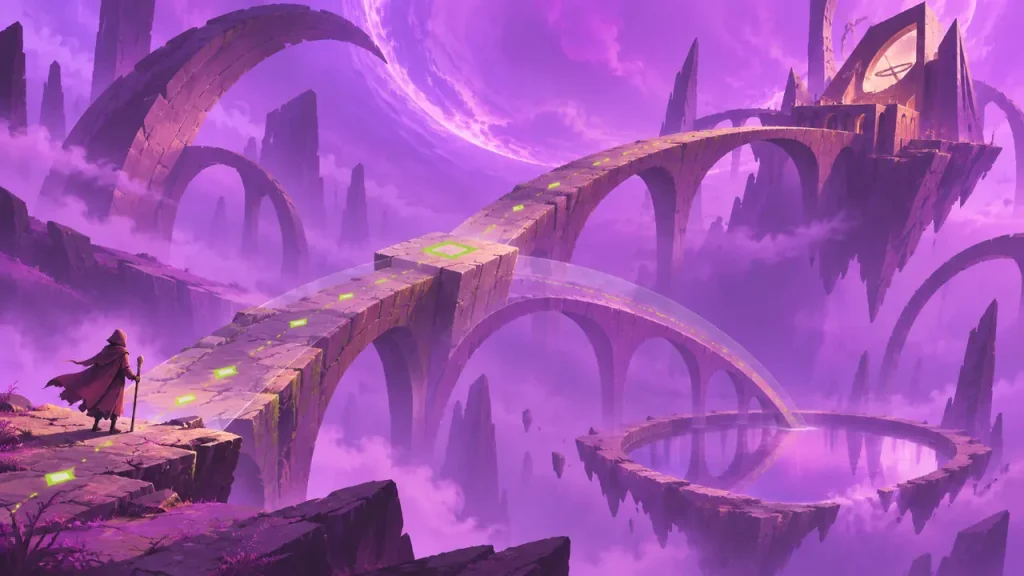
Both Banks is a spatial puzzle concept built around an unusual crossing. A ravine has two incompatible bridges, each incomplete when considered alone. A quantum wanderer can hold both arrangements open, but only through a relationship anchored in a shared landmark. The proposed challenge is to understand that relationship before stepping into the gap, then maintain or deliberately release it as the route develops.
The shared stone
The opening scene uses one unmistakable stone near the middle of the ravine. Its shape and position remain consistent in both arrangements. Around it, one bridge rises toward an observatory while the other descends toward a suspended pool. The stone gives the player a stable reference from which to compare the impossible geometry. Without such an anchor, the scene would risk becoming two attractive pictures with no readable connection.
The first task is observation rather than movement. The wanderer studies the near bank, locates the shared stone and identifies a fragment that can be reached in both views. A change in reality should reveal a new relationship to that fragment, not silently replace every useful landmark at once.
Prepare, hold, cross, release
The intended loop begins with preparing a view that includes the anchor and the next resting place. Holding the relationship opens the relevant fragments. Crossing moves the wanderer through the combined route while the condition remains visible. Releasing closes that connection at a stable point, allowing the player to reconsider the next section without continuing to maintain the previous one.
This sequence is deliberately more specific than a generic world-switch button. The concept needs to explain what is being held and why it matters. An interface cue can reinforce the link, but the architecture should do much of the work. A player ought to be able to describe which stone or opening keeps the route coherent.
A failure that teaches a relationship
Losing a connection should not automatically become a punishing fall. The proposal favours nearby stable resting points and a clear return to the last understood configuration. The useful information is which condition changed: the anchor left view, a required fragment was released, or the chosen landing belonged only to the other arrangement.
The shared-landmark note considers how to make these conditions visible. The undo design note asks how to support experimentation while preserving the significance of a committed crossing.
Art direction for contradictory space
The landscape uses violet stone, muted rose structures and isolated lime markers at readable connections. Broad silhouettes matter more than dense surface decoration. Reflections can suggest the alternate arrangement, but should not become the only way to identify it. The wanderer remains small against the architecture, giving the bridge room to communicate its scale and its gaps.
The two realities must also differ in shape, not just colour. One might use an ascending arc and the other a descending sequence of flat fragments. A visitor who cannot distinguish the palette should still understand which arrangement is active from the structure and accompanying labels.
Current stage and design target
Both Banks is at concept stage, with no playable release announced. The first target is one crossing whose rule can be understood, tested and explained without a long tutorial. Later complexity should grow from combining known relationships rather than adding an unrelated exception to every bridge. The companion Absent Stair concept brings these questions into a vertical interior, where shared landings replace the distant horizon.