
Switch the View, Keep the Reference
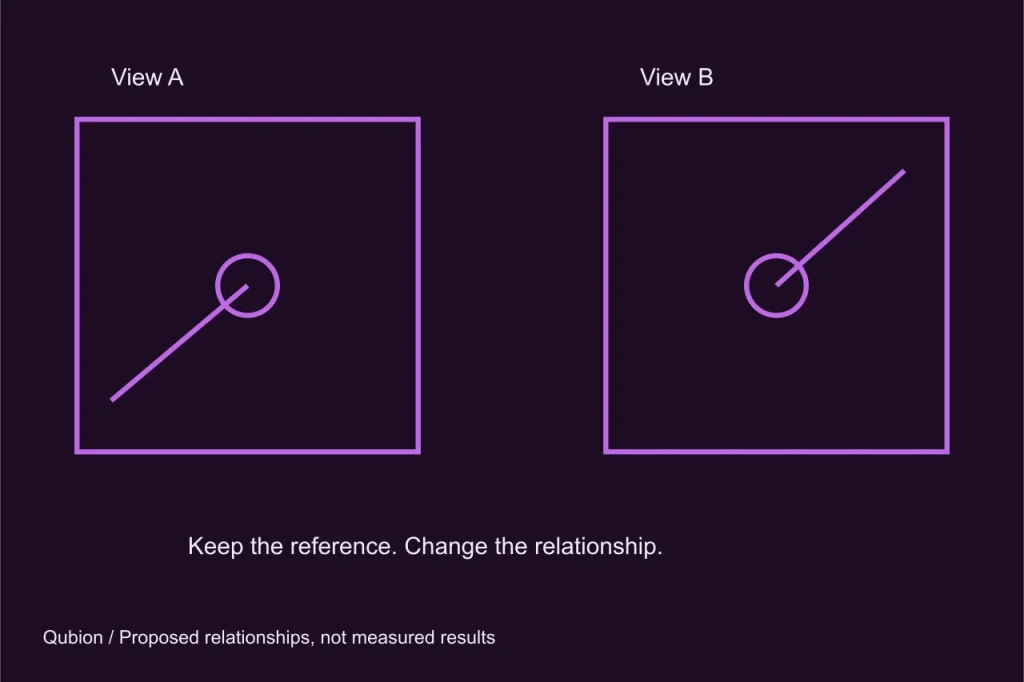
A reality change can be visually spectacular and still make a puzzle harder for the wrong reason. If the camera rotates, the room shifts and every landmark changes at once, the player may lose the reference they intended to compare. Absent Stair needs transitions that reveal a relationship. This note separates the information conveyed by a change from the spectacle used to present it.
Keep one frame of comparison
The proposed first transition holds the camera’s reference to a stable landing while the adjacent stair changes. The player can compare the same region before and after the change. A window or broken railing remains visible, connecting the two views. This does not require a motionless game; it establishes a dependable first example before introducing more complex movement.
The same idea applies to the distant bridge in Both Banks. A shared stone gives the view a centre of comparison. If the transition moves that centre offscreen, an otherwise clear rule may seem to produce an unexplained result. The camera should support the player’s current question rather than replace it with a new composition.
Observing is not committing
Looking at another arrangement should be distinguishable from making its connection active. The concept proposes an observation state in which the player can compare possibilities, followed by an explicit action that holds the chosen relationship. A clear boundary prevents casual exploration from accidentally changing a route the player was still trying to understand.
This distinction also creates useful interface language. A label can say that another arrangement is being viewed, while a separate indicator identifies the connection currently held. The two states should not be represented by nearly identical icons. The player needs to know whether they are gathering information or accepting a consequence.
Let the changed part explain itself
A transition can emphasise the structural difference: a missing stair becomes visible, a bridge fragment shifts, or a doorway opens onto a different floor. We would prefer that focused change to a full-screen flash that briefly conceals all spatial information. The effect should direct attention toward the relevant relationship, not demand that the player rediscover it afterwards.
An animation is only one presentation. A reduced-motion option should be able to show the same before-and-after states with a shorter dissolve or an immediate change and a clear label. If the rule depends on watching a particular animation frame, the underlying information is not yet robust enough.
Avoid a colour-only distinction
Violet and rose tones can help separate the two arrangements, but they are not sufficient identifiers. Structural silhouette, connection labels and the visible status of the held anchor should reinforce the difference. Screens with poor contrast, small viewports or altered colour perception should not turn the alternate reality into an indistinguishable copy.
The landmark study explains how a recognisable anchor supports these transitions. The camera, environment and interface need to agree about which object remains shared. A discrepancy between them could be interpreted as a deliberate clue even when it is only a presentation error.
A modest next evaluation
No completed playtest is claimed here. An early comparison could present the same room with two transition styles, then ask viewers to identify the changed connection and the currently held state. Preference alone would not settle the design question. A visually appealing effect that obscures the answer would still need revision.
The next layer of complexity should preserve these basic distinctions. Once players can reliably tell observation from commitment, the game can ask more demanding questions about which relationship to hold. Without that foundation, increasing the number of possible arrangements would add confusion rather than depth.